 Close
CloseUbuntu: Speak Up, Speak Out. Challenging Inequality
Challenging inequality, strengthening workplace wellbeing, and reshaping workplace culture
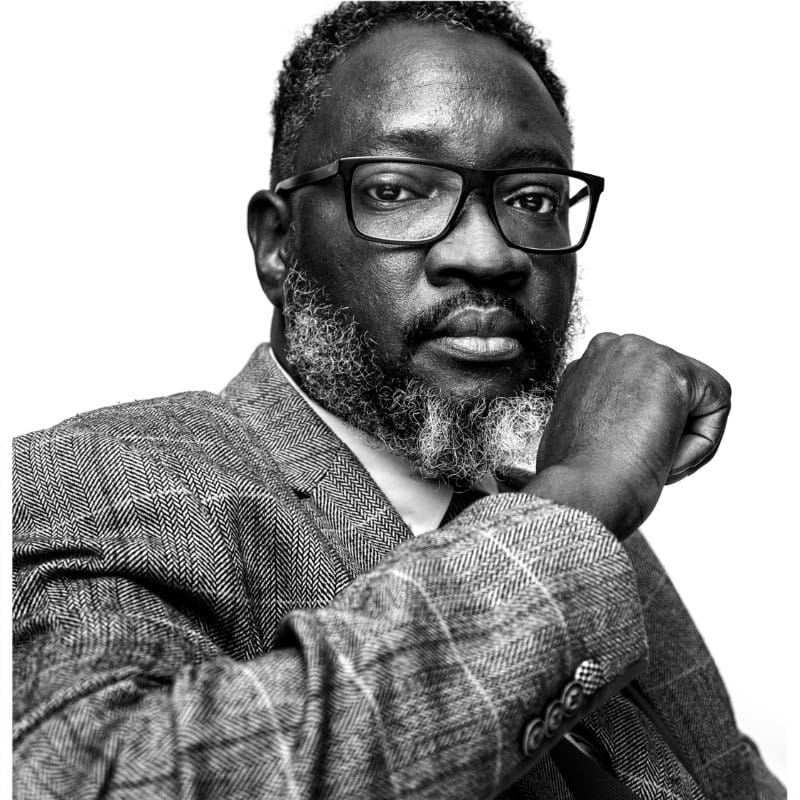
Ollie Folayan MBE
We explored a simple but uncomfortable truth: challenging inequality, workplace wellbeing and workplace culture are inseparable. You cannot meaningfully address mental health at work without also looking at power, inclusion, and whose voices are heard.
Amy McDonald and Angus Robinson were joined by Ollie Folayan MBE, Head of Process at Optimus Plus, Visiting Professor at the University of Dundee, and co-founder of AFBE-UK. Ollie’s reflections brought together ethical engineering, lived experience, and a deeply human understanding of what helps people feel safe, valued, and able to do their best work.
What followed was not theory. It was reality.
I aspire to have very clear principles and very clear values, and clear boundaries of things I would not do.
Values, boundaries, and the importance of nuance
Ollie began with an unexpected metaphor: a prism.
A prism has clear boundaries, yet it transforms white light into many colours. For Ollie, those boundaries represent values and principles. The light represents information, experience, and knowledge.
In today’s workplaces, we are surrounded by information, opinions, and assumptions. The danger is not lack of data, but lack of nuance. We cling to a single story, a single explanation, a single version of events. When we do that, we miss what is really happening to people.
This matters deeply for workplace mental health. Harm rarely shows up as one dramatic moment. It shows up in patterns, behaviours, silences, and small acts that slowly erode psychological safety.
Ethical work is people-centred work
As an engineer and academic, Ollie frames ethics as central to professional practice, not an optional add-on. He challenges the idea that work is only about delivery, cost, or timelines.
You can’t talk about ethics without talking about inclusion.
Ethical engineering, he explains, is not just about safety standards or compliance. It is about asking who is in the room when decisions are made, and who is missing. It is about understanding the long-term impact of decisions on people and communities.
This thinking applies far beyond engineering. Workplace wellbeing improves when organisations stop treating people as secondary to outputs, and instead recognise that good work is inseparable from human impact.
When workplace culture becomes harmful
Ollie shared openly about early experiences in his career that many will recognise. From his first days in work, he faced dismissive comments, humiliation, and sustained undermining. None of it happened in isolation. It accumulated.
After a while, I started to have anxiety quite regularly going into work. It had a real impact on my mental state of being.
What stood out was not just what happened, but what didn’t. There was no safe place to speak. No trusted person to turn to. Over time, Ollie began to doubt himself, questioning whether he was overreacting or at fault.
This is how toxic workplace cultures damage mental health. Not always through overt aggression, but through isolation, silence, and self-doubt.
Naming the problem restores agency
One of the most powerful moments in the conversation came when Ollie spoke about bullying and discrimination at work. Rather than offering a checklist, he offered a way of thinking.
The first question, he said, is not “Is this bullying?” but:
Do I believe the person is acting in good faith?
From there, he encourages people to look at proportionality, fairness, and impact. Are responses disproportionate? Are goalposts shifting? Is there repeated humiliation or shame?
And then comes a crucial step:
Give the problem a name. Define the problem.
Many people experiencing harm default to self-blame. Naming what is happening is not about accusation. It is about clarity. And clarity is what restores agency.
You always have agency. You’re never in a position where there’s nothing you can do.
That sense of agency is foundational to workplace mental health. Without it, stress becomes chronic and corrosive.
Impact, not accusation
Ollie described how a later experience in his career unfolded very differently. This time, he spoke to someone senior, not to accuse, but to explain the impact of what was happening.
My approach wasn’t to accuse. It was to describe the impact on me and how it was affecting my ability to do my best work.
This distinction matters. Impact-based conversations reduce defensiveness and create space for change. They also model the kind of communication that psychologically safe cultures depend on.
What creates real cultural change?
Drawing on years of working with organisations, Ollie outlined five conditions that support genuine inclusion and healthier workplace cultures:
- Candour – environments where people can speak honestly about what is working and what is not
- Cohesion – connecting initiatives rather than running disconnected activity
- Consistency – everyday behaviours, not one-off gestures
- Continuity – long-term commitment beyond individual roles or leaders
- Coalition – recognising that fairness and wellbeing are in everyone’s interest
Real change does not come from goodwill alone. It comes from systems, behaviours, and shared responsibility.
A quiet challenge to leaders
When asked what he says to leaders who pay lip service to wellbeing, Ollie was direct.
Do you really want this?
If not, do not waste people’s time. If you do, then commit to it properly.
Workplace wellbeing is not a slogan. It is revealed in how people are treated when things are difficult, uncomfortable, or inconvenient.
Ubuntu in practice
Ubuntu means “I am because we are.” This conversation reminded us that workplace mental health is collective. Culture is created every day, through what is tolerated, what is challenged, and whose experiences are taken seriously. Speaking up matters. But so does creating workplaces where people do not have to be brave just to be safe. If this article leaves you with one question, let it be this:
If you were radically honest about how work feels right now, would your workplace be ready to listen?
That question sits at the heart of workplace wellbeing, and it is where real change begins.
Final Thoughts
This conversation with Ollie Folayan reminds us that workplace wellbeing is not built on good intentions alone. It is shaped by everyday behaviours, honest conversations, and the courage to name what is really happening at work. When people feel heard, respected, and able to speak without fear, workplace culture becomes healthier and mental health is better protected.
Ollie’s reflections challenge organisations to move beyond surface-level commitments and towards cultures where inclusion, ethics, and psychological safety are part of how work is done. Not occasionally. Not performatively. But consistently and with intent.
🎧 Listen to Ubuntu: Speak Up, Speak Out! Challenging Inequality, an episode of the Headtorch Wellbeing Hour, available on Spotify and all major podcast platforms, to hear Ollie’s story and insights in full.
Headtorch works with organisations to create mentally healthy workplace cultures that support wellbeing, strengthen leadership, and enable people to thrive. If your organisation is ready to take meaningful steps towards better workplace mental health and wellbeing, get in touch to explore how we can support you.